Saturday, November 23, 2013

Skinny Venus appears on Vogue's Facebook Page

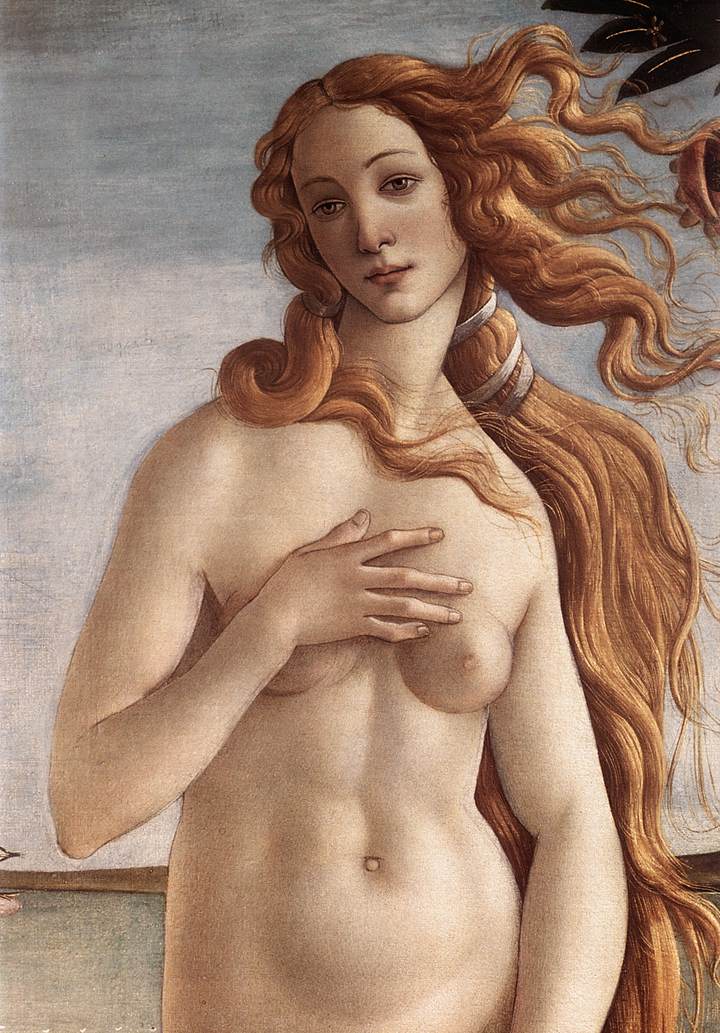
Scrolling through Vogue's Facebook page (Vogue's Official Facebook Page, 2013), I encountered something that was supposed to look like an illustration of 'The Birth of Venus'. I could not help but notice how Vogue's Venus does not look anything like Botticelli's (Web Gallery of Art, 2013). Only by comparing these two paintings, we can realize how much have the standards of female beauty shifted to the unhealthier side. Vogue's Venus has at least twenty kilos less, no breasts and barely any waist. The only thing that remains the same is hair; probably because its growth is not affected by food consumption. Perhaps this comment I found below Vogue's Venus on their Facebook page is not the most academically written one, but it does explain it all (Vogue's Official Facebook Page, 2013).
Vogue even dares to change art in its mission to promote objectification of women. Presenting the ultimate beauty, Venus, as a skinny and tall, model-looking girl, sends a message that this is how every girl should look. Promoting distorted and monotonous standards of beauty disrespects women on so many levels - it makes those that are not as skinny and do not fit in this small box of Vogue's less valuable. It also promotes the point of view that women are valuable only as look as they look good, that is, are skinny and tall. Hopefully, women should be emancipated enough by now to know that they are not objects to be put in boxes and should not let Vogue manipulate their minds.


Vogue's Official Facebook Page, 2013, Facebook, viewed November 21,
https://www.facebook.com/photo.php?fbid=10151990523537279&set=a.71982647278.106317.42933792278&type=1&theater
'Botticelli, Sandro: The Birth of Venus', 2013, Web Gallery of Art, viewed November 21, http://www.wga.hu/frames-e.html?/html/b/botticel/5allegor/30birth.html

VOGUE managed to be both sexist and racist

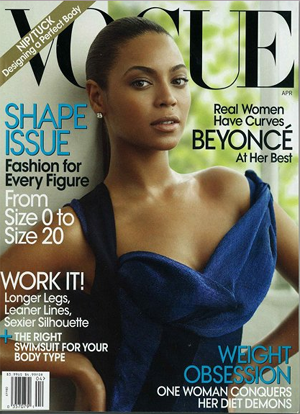
"Real women have curves", says Vogue (Shaping a Decade: Ten Years of Vogue Shape Issue Covers, 2012). The conclusion I have come to is - if you don't have curves, you're not a real woman? What if your curves are not the same as Beyonce's but they are curves? Are you still a real woman? I guess what Vogue is trying to say is - look at Beyonce, she's black and she's got curves - which is highly stereotypical for African-American women (Wade, 2009). Hence the accusation of racism. Nonetheless, Vogue also makes sure it attracts non-curvy audience by giving a series of advice. The message is the following: if you don't have curves, Vogue will tell you how to achieve a sexier silhouette - either by working out or a diet. Just in case neither of these two works, don't forget that plastic surgery can always make you more beautiful! Sadly, these are all headlines from this Vogue's edition cover page. Why is this a problem, you ask? For it objectifies women by telling them that all they need to do is look good. No need for them to worry about economy, war in Syria or climate change. They should only look great for their men who are too busy caring about all those things just mentioned. Smells like another failure for Vogue, and another challenge for feminism to me.

'Shaping a Decade: Ten Years of Vogue Shape Issue Covers', 2012, Vogue, viewed November 19, http://www.vogue.com/vogue-daily/article/the-past-decade-of-shape-issues/#1

Wade, L, 2009, 'Vogue Puts a Woman of Color on the Cover and Manages to be Both Sexist and Racist', The Society Pages, viewed November 19, 

Emma Stone calls Teen Vogue "sexist"


Hollywood actress Emma Stone apparently got tired of facing sexism in the media. Sexist questions seem to appear in interviews all the time, yet no one reacts to them. Last year, in an interview for Teen Vogue, Stone finally decided to speak up after hearing yet another question about her hair, the way she stays in shape and the lipstick she is using. Making a very important claim about how none of her male colleagues face the same type of questions, Stone openly said to the interviewer that it is, as simple as that, SEXISM (Emma Stone Covers Teen Vogue With Andrew Garfield, Reaches New Levels of Awesome, 2012). It is unfortunate that these reactions are rare among actresses, and that this was the first time someone so famous reacted ever since Helen Mirren was offended  because an interviewer asked her if her body helped her in career back in 1975 (Helen Mirren still mad over 35 year-old television interview with Michael Parkinson, 2010) . Not much has changed since. Actresses are still asked about their bodies before they are actually asked about their talents, work and opinion on important issues. No wonder young girls get distorted images of how they should feel about and value themselves after reading Teen Vogue or any other women's magazine, when their role models talk about diets and hairstyles at most times. Hopefully, more actresses (and actors) like Stone will speak up in the future, become new role models and influence young girls to think differently about themselves, as well as change the way young boys think about girls. All I can say is - go Emma!


'Emma Stone Covers Teen Vogue With Andrew Garfield, Reaches New Levels of Awesome', 2012, The Huffington Post, viewed November 22,  
http://www.huffingtonpost.com/2012/06/21/emma-stone-teen-vogue-andrew-garfield_n_1615278.html
'Helen Mirren still mad over 35 year-old television interview with Michael Parkinson', 2010, Daily Mail, viewed November 22, http://www.dailymail.co.uk/tvshowbiz/article-1313762/Helen-Mirren-mad-35-year-old-television-interview-Michael-Parkinson.html

VOGUE's cover promotes gender violence

Here's an example of how Vogue promotes gender violence - and it is not hidden at all. What I personally see on the cover of the French edition of Vogue (Vogue Homme international celebre un homme et une femme, 2012) is choking and harassment, and there is nothing sexy about it. Is this photo supposed to show men that 'a bit' of choking now and then is fine? And if so, what's next? 'A bit' of slapping, a black eye? There is a clear distinction between touching your partner in a sensual way and touching her to do her harm. Vogue obviously doesn't know that difference. Due to this cover, Vogue deserves a clear accusation of promoting sexism, that is, male dominance, female inferiority and gender-based violence. Covers like this one can easily change readers' point of view, leading them into thinking that violent relations between women and men are justified.

'Vogue Hommes International celebre un homme et une femme', 2012, Vogue Paris, viewed on November 21, http://www.vogue.fr/magazine/diaporama/vogue-hommes-international-celebre-un-homme-et-une-femme/9669

Welcome Note

This is a blog that aims to collect and discuss hidden sexists symbols in women's magazines. This week, the blog will focus on probably the most famous women's and fashion magazine VOGUE. Magazine Vogue, which generally aims to attract female audience, suffers from great criticism for frequently promoting violence, unhealthy lifestyle and the oppression and objectification of women. The series of posts that will follow will give more examples and criticism.